
Wheelie bins start Monday 12 October, a parking charge freeze with cash phased out goes to Cabinet on 20 October, and the overspend is £130,000.
This report was first published on 4 June 2026, when the council had said only that wheelie bins would arrive "in the autumn". On 1 October the council confirmed the switch for Monday 12 October and said most of the 45,000 households moving over now have their bins. The same evening its Cleaner and Greener committee backed a freeze on parking charges from April 2027, with cash phased out; Cabinet decides on 20 October. The 22 September Cabinet decisions are further down, and the rest of October's meetings are listed at the end.
Households across the Sevenoaks district are nine days away from the biggest shake-up to their bin collections in decades. Sevenoaks District Council is spending £9.05 million on new waste and recycling services, and wheelie bins with kerbside glass replace the green bags and sacks on Monday 12 October 2026. Its share of council tax went up 2.98% on 1 April, and next April’s parking charges are now on the table. Here is what has actually been decided, what is still a proposal, and what it means for your kerb, your bill and your parking.
What was decided
Two separate council decisions are landing on residents this year. The first is the “BIG recycling upgrade”, a phased overhaul of how rubbish and recycling are collected. The second is the 2026/27 budget, agreed by full council on 24 February 2026, which sets the council tax and funds the year’s spending.
The waste change started with food. From 27 April 2026, most households began receiving weekly food waste collections. According to the council, this reaches around 49,000 of the district’s roughly 53,000 homes, with hard-to-serve communal blocks and estates brought in later in the year. The wheelie bins, glass and alternate weekly collections follow on 12 October.
On the money side, the council set a budget of £22.3 million for 2026/27, more than £2 million up on the previous year, and raised its own portion of the council tax by 2.98%.
The bin changes, in order
The waste overhaul is being delivered in stages rather than all at once. Here is the sequence the council has set out.
From 27 April 2026: weekly food waste. Most homes, except flats, now get a weekly food waste collection. Residents receive two caddies: a small grey caddy for use indoors in the kitchen, and a larger black and orange caddy that goes out at the kerb. The council says food waste makes up around a third of what households throw away and is one of the heaviest items in the bin.
Mid-July to Sunday 11 October 2026: two free wheelie bins delivered. The council said on 1 October that most of the 45,000 households moving to the new service have their bins, and that deliveries continue for a small number until Sunday 11 October. Most households receive a 240-litre wheelie bin with a green lid for recycling and a 180-litre black wheelie bin for general waste. The recycling bin takes plastics, metal tins, cans and trays, paper, cardboard and, for the first time at the kerbside, glass bottles and jars. The council’s instruction is to keep the bins at your property and leave the seals on until one week before your first wheelie bin collection.
From Monday 12 October 2026: alternate weekly collections. The switch is district-wide on one day, not household by household. General waste and recycling are then collected on alternate weeks, one bin one week and the other the next. Food waste stays weekly. Each household should have had a postcard saying whether its first collection is recycling or general waste; if yours has not arrived, the council’s collection day finder has the dates. Green reusable bags will not be emptied from 12 October.
A small number of properties, such as flats above shops or homes without suitable storage or access, will not receive the bins and are likely to stay on their current arrangement. The council says communal recycling for flats will be improved in the coming years, with new banks for food waste, textiles and small electrical items.
What it means for you
For most homeowners and renters in houses, the practical changes are real and close.
- Your kitchen routine has already changed. Food scraps go in the grey indoor caddy and the black and orange caddy goes out weekly. That carries on unchanged after 12 October.
- Your bins should be with you. Most houses now have both. If your neighbours have theirs and you do not, the council asks you to wait 24 hours before reporting it, as crews may still be in the area; deliveries run until Sunday 11 October. You do not pay for the bins; the council has costed them into the £9.05 million programme.
- Leave the seals on for now. Keep using your current sacks and bags up to and including your last collection before 12 October, and only start filling the new bins one week before your first wheelie bin collection.
- Glass no longer needs a separate trip. From 12 October, glass bottles and jars go in the green-lidded recycling bin instead of being taken to a bottle bank.
- Check your postcard. From 12 October, general waste and recycling alternate week to week; the council’s postcard says which bin goes out first, and bins must be at the kerb by 7am.
- Flats are on a different timeline. If you live in a flat, you keep using communal facilities, with improvements promised over the next few years rather than this autumn.
The seals, the first collection week and whether you can refuse a bin (you cannot) are all covered on our Sevenoaks bin collection days page.
The council frames the upgrade partly as a response to new government rules requiring councils to offer a wider range of home recycling from 2026, and partly as a cost and carbon saving. It estimates the food waste change alone will save more than £500,000 a year in disposal costs paid to Kent County Council, because food waste is processed differently from general rubbish.
The cost, and where the money goes
The £9.05 million figure is not abstract. The council has broken it down into three main areas: £6.6 million for new waste collection vehicles, £2.09 million for the wheelie bins themselves, and £360,000 for the food waste containers.
Cllr Irene Roy, the council’s Cabinet Member for Cleaner and Greener, described the programme as “one of the biggest investments in the Council’s 51-year history”. On the food waste element, she said: “Food waste makes up around a third of household waste and is one of the heaviest things we throw away.”
The council tax side
Running alongside the bin changes is the council’s 2026/27 budget, agreed in February. The district council raised its own share of council tax by 2.98% from 1 April 2026. For a Band D home, that works out at an extra £7.47 a year, or about 14 pence a week, on the Sevenoaks District Council portion.
It is worth being clear about what that figure is and is not. The district council’s share is only one slice of your total council tax bill. The largest part goes to Kent County Council, with further amounts for the police, the fire service and your town or parish council. The 2.98% rise applies only to the district’s slice, not to the whole bill. For the full breakdown by band, see our page on Sevenoaks council tax bands.
The wider £22.3 million budget also funds capital projects beyond bins, including regeneration of land east of Sevenoaks High Street, new housing in Swanley, and a new community hall and shop on the Spitals Cross Estate in Edenbridge. Cllr Kevin Maskell, Leader of Sevenoaks District Council, said the authority could “once again set a balanced budget while investing more in services that are important to our residents”.
Parking: a freeze, with cash phased out
On Thursday 1 October the Cleaner and Greener Advisory Committee backed a package for 2027/28 that Cabinet will decide on Tuesday 20 October. If Cabinet agrees, it starts on 1 April 2027.
- No rise in car park or on-street charges, season tickets, permits or vouchers. The council’s benchmarking shows most other Kent councils raising charges by about 2.5%.
- Cash phased out at council pay machines. The council says 89% of parking payments already come by phone app or card; its 2025/26 parking report puts MiPermit at 67%, contactless at 22% and cash at 11%.
- A weekend charge at Gordon Road, the car park beside the council offices that is free on Saturdays and Sundays now. The officers’ report priced it at £5 a day and £60,000 a year in income, with £22,000 saved by ending cash collection.
The committee chose this over the other option in the report, a 2.5% rise on all fees and charges. The council’s announcement does not give the weekend price, and the meeting’s minutes are not yet published. The detail is in Sevenoaks parking charges frozen, but cash to go from April, and our parking guide lists every council car park.
What Cabinet decided on 22 September
Cabinet met at 7pm on Tuesday 22 September in the Council Chamber on Argyle Road and resolved six items. The draft minutes, and the notice that puts the decisions into force, were published the next day. Here is the record.
- Money: the overspend stands at £130,000, and the pay award adds £71,000 to it. Cabinet noted the financial monitoring report to the end of July, which forecasts an adverse variance of £130,000 by 31 March 2027. The Strategic Head of Finance told members the staff pay award has since been settled at 3.3%, which is forecast to cost £71,000 more than the budget allowed. The pressures named in the report are contractor costs in building control, lost Sunday Market rents and lower parking income at Bradbourne car park, where a privately owned car park is taking custom. The capital programme is £27.9 million this year and is forecast to come in slightly under, because the final retention payment on 27-37 High Street in Swanley brought that scheme in under budget. Members asked whether the Swanley Market contract, which expires in March 2027, could go to other operators or involve the town council.
- Borrowing: the internal cash has run out. Cabinet approved the treasury management annual report for 2025/26. The council earned £748,000 in interest last year at 4.43%, and took no new loans beyond short-term cash flow borrowing at the year end. On the £1.6 million of capital spending that was not funded, officers said it had been met by internal borrowing and that there is “no longer capacity” for more, so external loans have to be investigated. Up to £100 million of external borrowing has been approved and none of it has been drawn down. Members were told Public Works Loan Board rates are high, that some projects have already moved outside the council’s appetite for borrowing on feasibility grounds, and that each one will now be judged case by case. The background is on our page on Sevenoaks council finances.
- The Vine order runs to December 2029, from 1 October. The anti-social behaviour PSPO at The Vine was extended for a further three years. The consultation drew 143 responses, 60 of them from people under 18; 107 backed extending the order and 129 agreed with the prohibitions as they stand. No fixed penalty notices have been issued at The Vine this year. The decision takes effect on 1 October.
- Halstead car meets: a consultation, and new fine levels from 26 October. Cabinet agreed a four to six week public consultation on extending the PSPO at Hewitts Roundabout on London Road, Halstead, which was first made in 2024. Over four weeks this summer the council issued more than 100 community protection warnings and fixed penalty notices there; just over half of the fines were paid within 14 days, some are on payment plans and some have been contested and reviewed by Kent Police. New fine levels apply from 26 October and the money goes into the community safety budget. The council is also asking Transport for London to fit an ANPR camera to one of its lampposts, so that residents are not the ones filming. Both orders are covered in Vine PSPO extended, Halstead consultation agreed.
- A safeguarding policy, but not yet. The district safeguarding policy for 2026 to 2030 was agreed as a recommendation to full council rather than as a decision. The extraordinary council meeting set for the same evening was cancelled, so the policy waits for the next full council on Tuesday 1 December.
- Committee places. The membership of the Cabinet advisory committees, the CIL Spending Board and the Sevenoaks Joint Transportation Board for 2026/27 was approved, with immediate effect.
Two answers to councillors’ questions are worth recording. On finance, the Leader said that with local government reorganisation paused the council’s three-year budget no longer has a fixed timetable behind it and “a range of options” is being explored, with the ten-year budget as a firm base. On the regeneration of land east of the High Street, members were told the development agreement with the council’s chosen partner is still unsigned, and that a letter will go to businesses, councillors and local councils in the next few weeks setting out when the engagement programme begins.
Elsewhere, and the rest of October
- Abolition paused. On 7 September the Government paused local government reorganisation, including the decision to close Sevenoaks District Council in April 2028: what the pause changes.
- The green bags. Residents can keep them; the council plans a temporary service in early 2027 to collect any that people do not want. It says they cost £255,000, replaced around four million single-use sacks and produced a net saving of £225,000: wheelie bins start 12 October.
- The October diary. All at 7pm on the council’s meetings calendar: Housing and Health Advisory Committee on Tuesday 6 October, the Sevenoaks Joint Transportation Board on Tuesday 13 October, the Development Management Committee on Thursday 15 October, Cabinet on Tuesday 20 October (the parking decision) and Scrutiny on Thursday 22 October. Licensing hearings sit at 10.30am on 8, 21 and 27 October.
- The full detail of the bin switch, as announced in July: Sevenoaks wheelie bins recycling upgrade.
Sources
- Sevenoaks District Council, Wheelie bin collections from October 2026 (12 October start, delivery window, bin sizes, exemptions)
- Sevenoaks District Council, Cabinet, Tuesday 22 September 2026: agenda and draft minutes (all six resolutions, the financial monitoring and treasury figures, and the implementation notice published 23 September)
- Sevenoaks District Council, Council meetings: Council, 22 September 2026 (the extraordinary Council meeting cancelled; next Council 1 December 2026)
- Sevenoaks District Council, Countdown begins to new wheelie bin collections, including glass recycling! (1 October 2026) (45,000 households, deliveries to 11 October, postcards, green bags no longer emptied)
- Sevenoaks District Council, Councillors propose parking charge freeze (2 October 2026) and the Cleaner and Greener Advisory Committee papers, 1 October 2026 (the freeze, cash, Gordon Road and the income figures)
- Sevenoaks District Council, Monthly meetings calendar, October 2026 (the October meeting dates, checked 3 October)
- Sevenoaks District Council, Council gears up for new weekly food waste collections (19 March 2026)
- Sevenoaks District Council, New beginning for waste collections (£9.05m investment breakdown and Cllr Irene Roy quote)
- Sevenoaks District Council, The BIG recycling upgrade
- Sevenoaks District Council, Latest budget invests more in local services and the future of the District (2026/27 budget, council tax and Cllr Kevin Maskell quote)
- Sevenoaks District Council, Rubbish and recycling
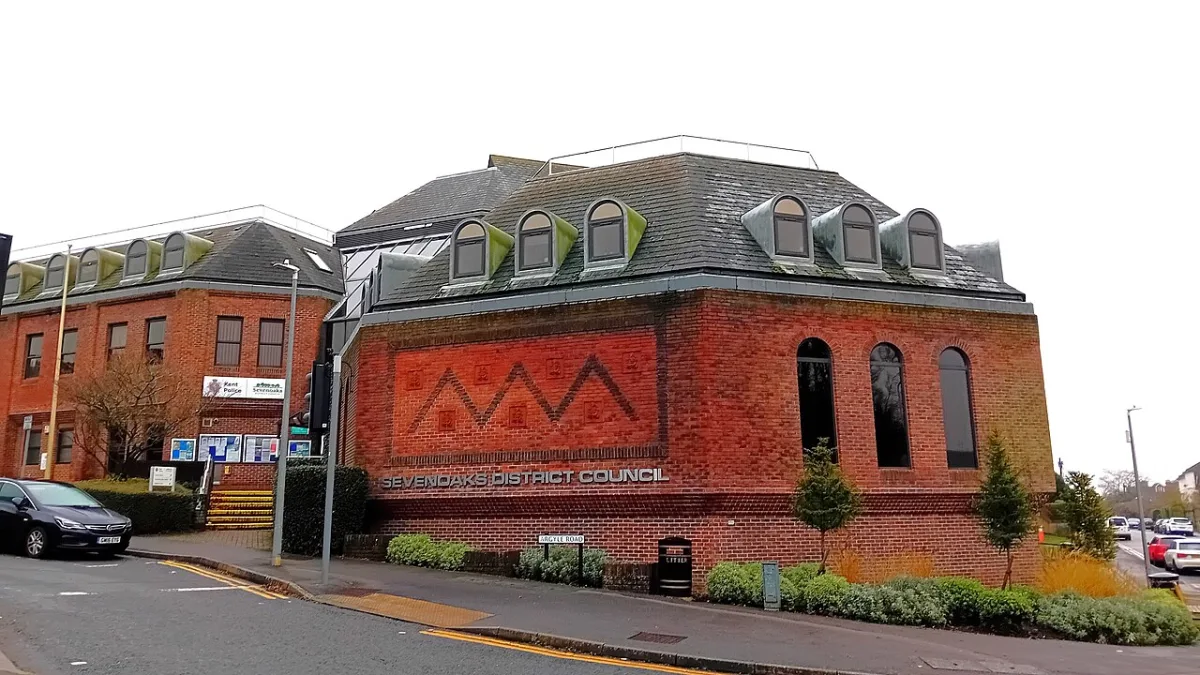
Image: “Sevenoaks District Council Offices” by Richard Kelly, CC BY 4.0, via Wikimedia Commons (https://commons.wikimedia.org/wiki/File:Sevenoaks_District_Council_Offices.jpg).
Have your say