
The 8 September rain nearly doubled the Darent at Lullingstone. Eleven days on it reads 0.173 again, exactly where it sat before. Both bans still run.
Rain fell hard on the district on 7 and 8 September, 23.3mm in two days at the Environment Agency’s Westerham gauge, and the River Darent answered within hours. At Lullingstone it climbed from 0.17 cubic metres a second to 0.333, the strongest the river had run since 27 June. Eleven days later, on 19 September, it read 0.173. That is the same figure it showed on 6 September, before a drop of that rain fell, and within a thousandth of where it sat on 21 August before the rain that came at the end of that month.
Two bursts of rain, two lifts, and the river back at the same number both times. The bans have not moved either. South East Water’s is still in force across its whole area, Thames Water’s is still in force across its whole area, and the Environment Agency’s assessment published on 19 September keeps “Kent and South London” in drought, with no change to any area’s status again this week. (Environment Agency, Dry weather and drought in England: 11 to 17 September 2026)
England has had 48 per cent of its average September rainfall so far, and the south-east took just 6mm in the week to 17 September. Reservoir storage for England fell again, to 56.1 per cent, nearly 20 percentage points below average for the date. Temporary use bans now cover around 30 million people.
Thames Water puts it plainly in its own update, last revised on 17 September: “While recent rainfall is welcome, sustained rainfall is still needed before restrictions can be lifted.” (Thames Water, temporary hosepipe ban)
Most households in the Sevenoaks district have been under a hosepipe ban since early July. Which ban, and therefore which rules, depends on who sends your water bill.
Three water companies, three different answers
The district is not served by a single water company, and each has taken a different position:
- South East Water supplies most of the district. Its Kent hosepipe ban came into force at 00:01 on Friday 3 July 2026 and is still running. Restrictions were extended to Sussex, Surrey, Hampshire and Berkshire from 25 July, so the ban now covers the whole company. Its own regional dial still shows Kent on black, the top of its four-step scale, which is the step that means restrictions are in place. (South East Water, hosepipe restrictions in all areas)
- Thames Water has a ban across its whole supply area, in force from 00:01 BST on Thursday 23 July 2026 and continuing “until further notice”. The Environment Agency has it at operational drought level 2 in every one of its resource zones, and on 17 September it applied for a drought permit at Farmoor. (Thames Water, temporary hosepipe ban legal notice)
- SES Water, whose area reaches east as far as Edenbridge, has no ban at all. It takes about 85 per cent of its supply from groundwater, which it says last winter recharged to healthy levels, and its own resources page still reads: “SES Water’s resources remain in a relatively healthy position and there are currently no plans to introduce a hosepipe ban.” (SES Water, rainfall and resources)
So a household near Edenbridge may lawfully use a hosepipe while a neighbouring village cannot. The dividing line follows the water network, not the parish boundary, so the only reliable way to know is to check your own postcode. Both banning companies publish a checker:
There is a local twist. SES Water draws 15 per cent of its water from Bough Beech reservoir, which sits inside the Sevenoaks district near Edenbridge, and supplies 750,000 people across parts of Surrey, Kent and south London. (SES Water, About us) Because the groundwater held up, the company says it has not had to lean on Bough Beech. The reservoir was 56.2 per cent full at its latest update, down 2.1 points in a fortnight. Its groundwater reading has gone the other way: 3.03 metres below the long-term average, three-quarters of a metre better than the 3.78 it reported two weeks earlier, which is the September rain reaching the chalk. (SES Water, rainfall and resources)
What the ban actually stops you doing
South East Water’s ban is a statutory notice made under sections 76 and 76A-C of the Water Industry Act 1991. It prohibits eleven uses of treated mains water:
- watering a garden using a hosepipe
- cleaning a private motor vehicle, or a trailer, using a hosepipe
- watering plants on domestic or other non-commercial premises using a hosepipe
- cleaning a private leisure boat using a hosepipe
- filling or maintaining a domestic swimming or paddling pool
- drawing water by hosepipe for domestic recreational use, such as hot tubs
- filling or maintaining a domestic pond, manmade or natural, using a hosepipe
- filling or maintaining an ornamental fountain, including by permanent plumbing
- cleaning the walls or windows of domestic premises using a hosepipe
- cleaning paths or patios using a hosepipe
- cleaning other artificial outdoor surfaces using a hosepipe
(South East Water, statutory notice for temporary use ban)
“Hosepipe” is defined widely. The notice covers “anything designed, adapted or used to serve the same purpose as a hosepipe”, which takes in garden sprinklers, irrigation systems and anything attached to them, including pressure washers.
Watering cans and buckets are not affected. Neither is a hosepipe fed from a water butt or another recycled water store.
The penalty is real but rarely used. Under section 76(5) of the Act, breaking the ban is a criminal offence carrying a fine of up to £1,000 on conviction in a magistrates’ court. South East Water’s own enforcement policy says it will normally offer advice first, and that prosecution is reserved for some cases. (South East Water, temporary use ban enforcement policy)
Who is exempt
South East Water applies two categories of exemption. Customers on its Priority Services Register who cannot reasonably adapt are exempted automatically and told directly. A second group of uses is pre-approved and needs no application:
- health and safety, including preventing risk to human or animal health
- animal welfare, including fish
- water drawn from a water butt or other recycled store
- newly laid lawns and new swimming pools
- drip or trickle irrigation with a pressure reducing valve and a timer, not handheld
- commercial watering, business need and religious practice
Sports pitches are a partial exemption. A hosepipe may be used on the playing surface itself, not the wider grounds, and only outside the peak hours of 8am to 10am and 5pm to 9pm.
Allotments are treated as gardens where they are used non-commercially, so they are covered by the ban. Land used commercially to grow crops, fruit, vegetables or plants for sale is not. Plants in outdoor pots, or in the ground under cover in a greenhouse or outbuilding, also fall outside the definition of a garden.
Thames Water’s notice lists a longer set of 23 exemptions on similar lines, with the same £1,000 maximum fine.
What the district’s own river shows
The clearest local measure of how dry this summer has been is the River Darent, the chalk stream that runs from Westerham through Otford and Shoreham to the Thames. The Environment Agency gauges it at several points, and publishes the daily figures as open data. We analysed them.
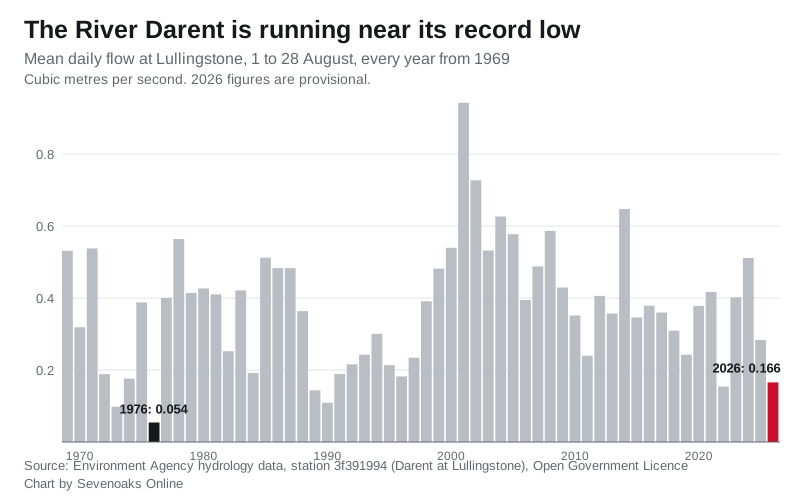
- At Lullingstone, the Darent averaged 0.166 cubic metres a second over 1 to 28 August this year. That is the sixth lowest reading for those dates in a record going back to 1969. Only 1976, 1973, 1990, 1989 and 2022 were drier.
- At Westerham, near the head of the river, the same period averaged 0.022 cubic metres a second, the lowest for those dates in a record that starts in 1995. The previous low was 0.025 in 2019.
- At Otford, where the 2026 record stops on 2 August, July’s mean flow of 0.179 was the fourth lowest July since 2000.
Two cautions on those numbers. The Environment Agency marks 2026 readings as “unchecked”, meaning they are provisional and may be revised. And a chalk stream in a dry summer is not the same as a river in flood risk terms; the Darent has run low before, most severely in the 1970s and again in 2022.
Two lifts, and the river back at the same number both times
The rain of late August shows up clearly in the gauges. So does the bigger fall of 7 and 8 September. So does how completely each one has drained away since.
| Date | Lullingstone | Westerham |
|---|---|---|
| 21 August, before the first rain | 0.172 | 0.022 |
| 29 August, the first peak | 0.253 | 0.031 |
| 6 September, back down | 0.173 | 0.022 |
| 9 September, the second peak | 0.333 | 0.024 |
| 12 September | 0.233 | 0.022 |
| 16 September | 0.203 | 0.022 |
| 19 September | 0.173 | 0.022 |
The second burst of rain was twice the size of the first, and it did more. At Lullingstone the Darent went from 0.17 on 7 September to 0.333 on the 9th, the highest it had reached since 27 June. Then it fell back over the next ten days to 0.173, the identical reading to 6 September and a thousandth off the 0.172 it showed on 21 August.
At Westerham, the small gauge near the head of the river, the rain bought a single day. The flow touched 0.045 on 8 September, was back to 0.024 within twenty-four hours, and has printed 0.022 every day from 12 to 19 September, eight readings without a flicker and the same number it was showing in the third week of August.
The rain gauge explains why. Westerham recorded 9.86mm on 7 September and 13.46mm on the 8th, then 5.9mm across the ten days since. Two wet days do not recharge a chalk stream that has been running low since spring; they run off, and the river returns to whatever the aquifer beneath it can supply.
That is the pattern the Environment Agency keeps warning about: some rivers respond, but the response is short-lived if dry weather returns. The 19th is the most recent day the agency has published, and its 2026 readings are still marked unchecked, meaning provisional and open to revision.
The drought is showing elsewhere in Kent. The agency still has the fish and canoe passes closed on the River Medway and says it is struggling to hold the published navigation depth at several points on the river, with weed growth in places. None of that has eased with the rain.
The reservoirs tell the same story on a national scale. Storage for England was 56.1 per cent for the week ending 15 September, 19.7 percentage points below average for the time of year, and it has kept falling through both wet spells. Thirteen reservoirs or reservoir groups are now less than half full, six are classed as exceptionally low, and one of those six is South East Water’s Ardingly. The Environment Agency names only three reservoirs in the country it is watching closely for their levels, and Ardingly is one of them, alongside Wimbleball and Clatworthy in the south-west. Ten agency areas are in drought, Kent and South London among them, and not one changed status this week. (Environment Agency, Dry weather and drought in England: 11 to 17 September 2026)
The two companies’ own numbers show the split. South East Water still has Ardingly at 34.8 per cent full and Arlington at 55.7 per cent, the reading for Sunday 6 September. Its page says it is updated weekly; it has not moved in a fortnight. (South East Water, reservoir levels) Ardingly had lost 9.4 percentage points in the fortnight to 6 September, from 44.2 per cent on 23 August. SES Water’s Bough Beech, inside the Sevenoaks district, is 56.2 per cent, which the company calls about normal for the time of year. They are not like for like. Bough Beech is filled from the River Eden over the winter and has barely been drawn on this summer, which is much of the reason one side of the district has a ban and the other does not.
South East Water’s application for a drought permit on the River Ouse, the river it refills Ardingly from, went in on 28 August. It asks for two things: to cut the water it is obliged to release from Ardingly into the Shell Brook, and to lower the minimum flow that must be left in the Ouse after the company has taken its share. The consultation has now closed and the Environment Agency has yet to rule. (South East Water, drought permit application) Across its area the company sits at operational drought level 2 in the Eastbourne and Haywards Heath resource zones and level 1 everywhere else, Kent included.
What it means for you
If you live in the Sevenoaks district, assume a hosepipe ban applies unless you have checked and found otherwise. The practical steps:
- Check who supplies your drinking water by postcode, using the links above. Your sewerage company may be a different company entirely, so the name on your wastewater bill is not the answer.
- Use a can or a bucket for the garden. Neither is restricted by any of the bans.
- Apply for an exemption if you are on a Priority Services Register or one of the pre-approved activities applies. South East Water asks customers to add the activity to their account rather than assume.
- Do not expect an end date. South East Water says the ban will run until demand falls, resources recover and there is no further supply risk, and that it keeps the position under constant review. Two wet spells have now been tried, and neither moved it. Thames Water says it needs sustained rainfall before it lifts anything. The National Drought Group, which coordinates the response, meets weekly; its 21 September meeting is on environmental impacts, and the Environment Agency has logged 349 confirmed drought incidents so far in 2026, already past the 321 recorded in the whole of 2025.
The Darent is also the subject of a longer local argument. Sevenoaks Town Council said in July it had donated to a project looking at solutions for the river, and has been lobbying for stronger protections. (Sevenoaks Town Council, Sevenoaks Town Council lobbies for River Darent protections)
The riverside stretches remain open to walk, and several of them appear in our guide to family walks near Sevenoaks. If you are planting this autumn, our roundup of garden centres near Sevenoaks may be useful, though watering in new plants by hosepipe is one of the restricted activities unless a professional landscaper did the planting.
Sources
- Environment Agency, Dry weather and drought in England: 11 to 17 September 2026
- South East Water, hosepipe restrictions in all areas
- South East Water, drought permit application on the River Ouse
- South East Water, reservoir levels at Ardingly and Arlington
- South East Water, statutory notice for temporary use ban (PDF)
- South East Water, temporary use ban enforcement policy (PDF)
- South East Water, hosepipe ban FAQs
- Thames Water, temporary hosepipe ban
- Thames Water, temporary hosepipe ban legal notice
- SES Water, rainfall and resources
- SES Water, About us
- Environment Agency hydrology data, River Darent daily mean flow at Lullingstone, Otford and Westerham, and daily rainfall at Westerham, Open Government Licence
- Sevenoaks Town Council, lobbying for River Darent protections
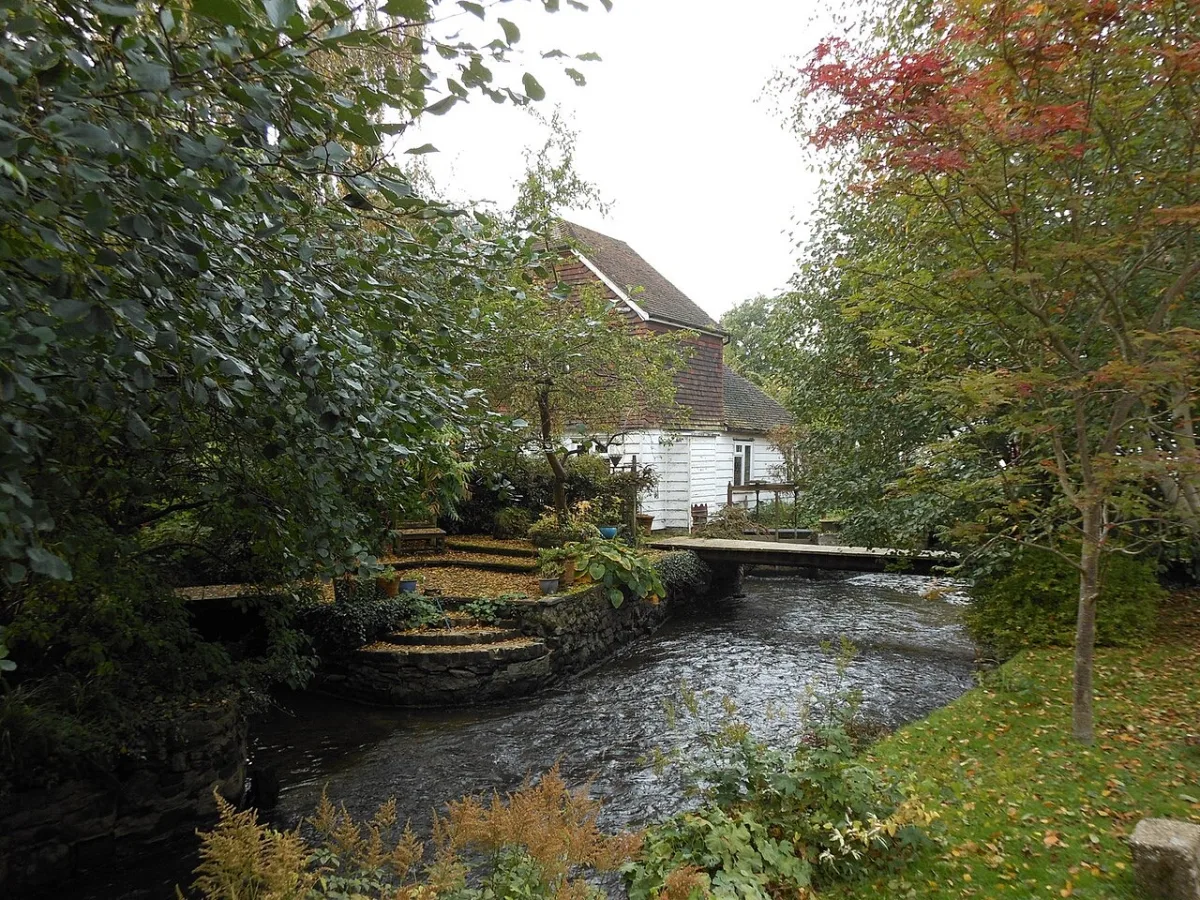
Image: The River Darent at Otford, photo by Trevor Harris, CC BY-SA 2.0, via Geograph Britain and Ireland.
Have your say